
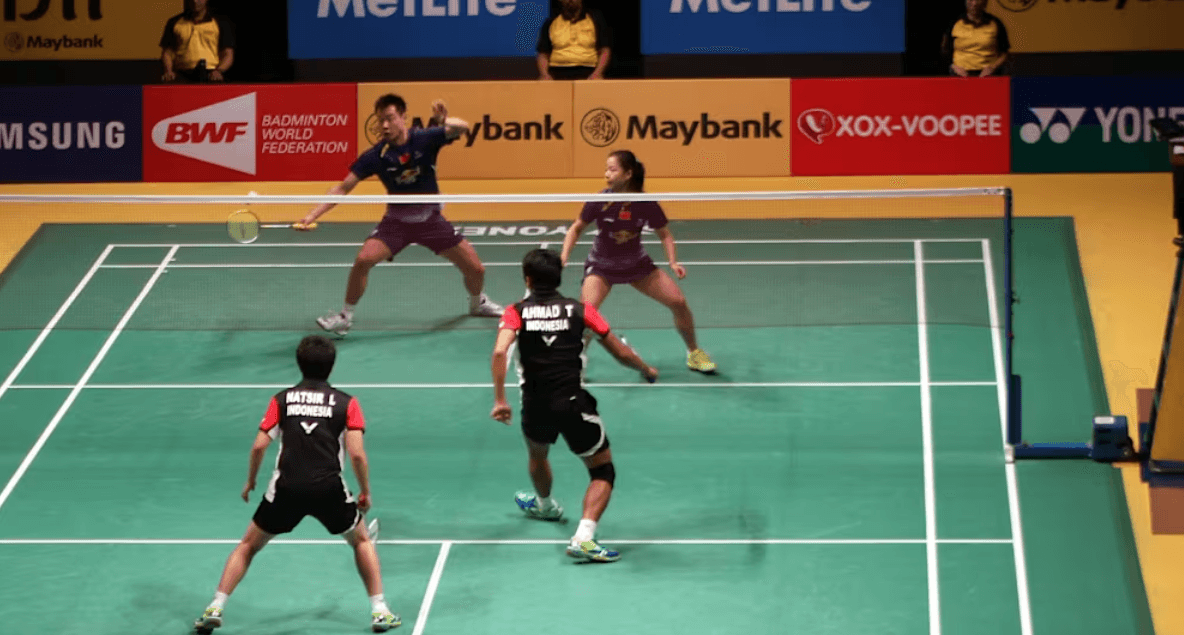

Badminton doubles is played by two players on each side of the net. The game uses the full width of the court during rallies, but the service area is shorter than the rally area. Players also follow a specific serving order based on their team’s score.
The most confusing part for beginners is rotation. Unlike some other racket sports, badminton doubles does not use a simple sequence in which partners take turns serving after every point. The same player continues serving when their team wins a rally on its own serve. The pair changes service courts, and the score determines where the next serve must come from.
This guide explains the badminton doubles rules in simple terms. It covers court boundaries, serving, player rotation, scoring, faults and common situations. It also explains the scoring formats used in international and Indian domestic badminton as of 26 November 2026, including the BWF scoring change scheduled for January 2027.
What Are the Basic Badminton Doubles Rules?

A standard doubles match has four players, with two players on each team. Each side works together to send the shuttle over the net and land it inside the opponent’s court.
The main badminton doubles rules are:
- Each team has two players.
- The full width of the court is used during rallies.
- Every rally produces one point for the winning side.
- Players serve diagonally into the opponent’s service court.
- The serving court depends on the serving team’s score.
- Only one player serves during each service turn.
- Players change their service courts only when their team wins a point while serving.
- A standard match consists of the best of three games.
These rules apply to men’s and women’s doubles. Mixed doubles follows the same basic scoring and service rules, although each team consists of one male and one female player.
Badminton Doubles Court Size and Boundaries
The doubles court is wider than the singles court. It measures 13.40 metres in length and 6.10 metres in width. The outer sidelines count during normal rallies.
However, the service area has a different back boundary. A doubles serve must land before the long service line for doubles, which is inside the back boundary line.
| Court marking | Doubles rule |
| Court length | 13.40 metres |
| Court width | 6.10 metres |
| Side boundary during rallies | Outer doubles sideline |
| Back boundary during rallies | Rear boundary line |
| Side boundary during service | Outer doubles sideline |
| Back boundary during service | Inner long service line for doubles |
| Short service line | Applies to both singles and doubles |
The service court is therefore wider and shorter than the full rally area. A shuttle that lands beyond the doubles long service line during a serve is out, even if it would have been inside the court during a rally.
Important: All court boundary lines form part of the area they define. If the shuttle touches a boundary line, it is considered in.
Badminton Doubles Rules for Serving
Serving is one of the most important parts of doubles badminton. A correct serve must travel diagonally from the server’s court into the receiver’s service court.
The serving position depends on the serving team’s score.
Even and Odd Score Rule
The basic rule is easy to remember:
- Even score: Serve from the right service court.
- Odd score: Serve from the left service court.
For example, if your team has zero, two or four points, the server stands in the right service court. If your team has one, three or five points, the server stands in the left service court.
The score of the serving team decides the position. The opponent’s score does not determine which side the server uses.
Diagonal Service Rule
The server must send the shuttle into the diagonally opposite service court. The receiver must stand in that correct diagonal court.
For example, when a player serves from their right service court, the receiver stands in their left service court. When the server serves from the left, the receiver stands in the opponent’s right service court.
Only the correct receiver can return the serve. If the receiver’s partner hits the serve, the receiving side commits a fault.
Legal Service Requirements
A legal serve must follow these conditions under the BWF Laws of Badminton:
- The server and receiver must stand in diagonally opposite service courts.
- Neither player may touch the service court boundary lines while serving or receiving.
- Some part of both feet must remain in contact with the court surface and stay stationary until the serve is delivered.
- The whole shuttle must be below 1.15 metres when the racket makes contact.
- The server must release the shuttle without adding spin.
- The racket must initially hit the base of the shuttle.
- The racket movement must continue forwards until the serve is delivered.
The current service rules do not require the racket shaft to point downwards at contact. The fixed service height and other conditions above are the important requirements.
What Happens If a Serve Touches the Net?
A serve that touches the top of the net but still lands inside the correct diagonal service court is legal. The rally continues, and the receiving player must return the shuttle.
It is not automatically called a let simply because the shuttle clips the net. A let is called only in situations covered by the rules, such as when the receiver is not ready and makes no attempt to return the serve.
If the shuttle becomes caught on or in the net after passing over it, the situation is treated according to the relevant fault rules.
This distinction is useful for beginners because a net-cord serve can still win or lose a point like any other legal serve.
Badminton Doubles Rotation Rules Explained
Rotation is where many new players make mistakes. The key is to understand when partners change service courts and when they stay in place.
When the Serving Team Wins a Rally
If the serving team wins the rally, it receives one point. The same player serves again from the alternate service court.
The two partners therefore change their left and right service positions. The next service still depends on the serving team’s updated score.
When the Receiving Team Wins a Rally
If the receiving team wins the rally, it receives one point and gains the right to serve.
Neither player changes their service court at this stage. The player who is standing in the correct service court for the team’s new score becomes the server.
Official Doubles Service Order
The right to serve passes between the four players in a specific sequence. This order helps explain why the same player does not serve continuously after their team loses a rally.
The official service order is:
- The initial server.
- The partner of the initial receiver.
- The partner of the initial server.
- The initial receiver.
- The sequence repeats in the same order.
The sequence applies as the right to serve passes between the teams. Within a team’s service turn, the same player continues serving if the team wins a rally, changing service courts after each point.
When Do Players Change Positions?
| Match situation | What happens |
| Serving team wins a rally | The team scores and the same player serves again from the other service court |
| Receiving team wins a rally | The receiving team scores and becomes the serving team |
| Serving team loses a rally | The serve passes to the opponents |
| Receiving team gains the serve | Both players remain in their existing service courts |
| A new game begins | Either player of the team that won the previous game may serve first |
Simple Doubles Rotation Example
Imagine Team A has players A and B, while Team B has players C and D.
- Score 0–0: Player A serves from the right service court to player C.
- Score 1–0: Team A wins the rally. A serves again from the left service court. A and B change service courts.
- Score 1–1: Team B wins the next rally. It gains the serve. Neither team changes service courts because of this point.
- Score 2–1: Team A wins the next rally and becomes the serving team. The score is now even, so the server must be in the right service court. Player B is standing there, so B serves.
This example shows why partners do not simply take turns serving after every point. The score and their court positions determine who serves.
Badminton Doubles Scoring Rules
As of 26 November 2026, the standard international BWF scoring system remains the 21-point rally scoring system.
Every rally gives one point to the side that wins it. It does not matter which team served.
The main scoring rules are:
- A match is played as the best of three games.
- A team must reach 21 points to win a game.
- At 20-all, a team must gain a two-point lead.
- If the score reaches 29-all, the next point wins the game.
- The maximum game score is 30–29.
- The team that wins a game serves first in the next game.
For example, a score of 21–18 wins the game. If the score reaches 20–20, play continues until one team leads by two points. At 29–29, the next point decides the game.
Intervals in the Current 21-Point Format
Under the current international 21-point system, players receive an interval of up to 60 seconds when the leading score reaches 11 points in a game.
There is also an interval of up to 120 seconds between the first and second games and between the second and third games when a deciding game is required.
These breaks allow players to rest, receive coaching and prepare for the next stage of the match.
Scoring System Used in Indian Domestic Tournaments

Source Image: olympics
Although the BWF’s standard international scoring rules remain based on the 3×21 format until 3 January 2027, India has already introduced the new 3×15 system in domestic badminton competitions.
The Badminton Association of India (BAI) began implementing the format across domestic ranking tournaments, zonal championships and national championships from July 2026.
The implementation covers different age groups and competition categories, including senior and masters competitions, under the applicable BAI regulations and circulars.
Therefore, players competing in Indian domestic events may already be using the 15-point format, while international competitions continue to follow the 21-point system until the BWF’s scheduled change.
Players should check the specific tournament regulations to confirm which scoring format applies to their competition.
When Do Players Change Ends?
Under the current 21-point system, players change ends at the end of the first game. They also change ends after the second game if a third game is required.
In the deciding third game, players change ends when one side first reaches 11 points.
Important BWF Scoring Change from January 2027
The Badminton World Federation approved a new 3 games by 15 points scoring system at its Annual General Meeting on 25 April 2026. It is scheduled to take effect internationally on 4 January 2027.
Under the new system:
- A match remains the best of three games.
- Each game is played to 15 points.
- At 14-all, a team must lead by two points.
- At 20-all, the next point wins, making 21 the maximum score.
- Players change ends in the deciding game when one side first reaches eight points.
- An interval of up to 60 seconds is allowed when the leading side reaches eight points in each game.
- The interval between games remains up to 120 seconds.
The service and doubles rotation rules remain separate from this scoring change. The main difference is the number of points required to win a game and the related interval and change-of-ends arrangements.
The two scoring formats therefore have different maximum scores and interval arrangements:
| Rule | Current 3×21 system | New 3×15 system |
| Games per match | Best of three | Best of three |
| Points per game | 21 | 15 |
| Two-point lead required | At 20-all | At 14-all |
| Final deciding score | 29-all | 20-all |
| Maximum game score | 30–29 | 21–20 |
| Interval during game | At 11 points | At 8 points |
| Change of ends in deciding game | At 11 points | At 8 points |
| International implementation | Current until 3 January 2027 | From 4 January 2027 |
Players should check the competition regulations because some domestic events may use an approved alternative format or may already have adopted the new scoring system.
Common Faults in Badminton Doubles
A fault ends the rally and awards a point to the opposing team. Players should understand these common situations:
| Fault | What happens |
| Service fault | The serve breaks one or more service rules |
| Shuttle out | The shuttle lands outside the court boundaries |
| Net fault | A player touches the net or its supports with their racket, body or clothing during play |
| Double hit | A player hits the shuttle twice in succession, except for contact with the racket head and stringed area during one stroke |
| Partner contact | Both partners hit the shuttle one after the other |
| Body contact | The shuttle touches a player’s body or clothing |
| Carrying | The shuttle is caught and held on the racket before being slung during a stroke |
A wrong service court is a service court error rather than an ordinary rally fault. If the error is discovered, the umpire corrects the players’ positions when the shuttle is not in play. The existing score remains unchanged.
A player may follow through over the net with the racket after making a legal contact on their own side. However, reaching over the net to hit the shuttle before it crosses is a fault.
Players should also remember that touching the net with their racket, body or clothing during play is a fault.
Doubles Positioning and Teamwork
The rules explain where players serve and receive. They do not require partners to remain in fixed attacking or defensive formations during rallies.
Most doubles teams use two main formations.
Side by Side Formation
Players stand on the left and right sides of their court. This formation is useful when defending against smashes and powerful attacking shots. Each player covers one half of the court.
Front and Back Formation
One player covers the front court while the other stays towards the rear. This formation helps a team attack with smashes, drops and net shots.
Good communication is important. Partners should call for the shuttle, avoid moving into the same space and cover gaps when the other player moves forward or backwards.
Conclusion
Badminton doubles rules become easier once players understand the service court, score-based serving and partner rotation. The full width of the court is used during rallies, while serves must land inside the shorter doubles service area. Only the serving team changes service courts after winning a rally on its own serve.
As of 26 November 2026, the standard international scoring system remains 21 points per game. Under this format, players receive a 60-second interval when the leading side reaches 11 points. India has already introduced the 15-point format in domestic competitions from July 2026. The BWF’s new 3×15 system is scheduled to take effect internationally on 4 January 2027.
Players should also remember that a serve touching the net is not automatically a fault or let. If it lands in the correct service court, the serve is legal. Learning these rules helps players avoid service errors, improve teamwork and understand the formats used in different competitions.
Frequently Asked Questions
Two players compete on each side. Teams use the full court width during rallies, serve diagonally and score one point for every rally won. A standard match is the best of three games.
The server serves diagonally into the opponent’s service court. The serving team’s score decides the side. An even score means the right court, while an odd score means the left court.
No. The serving team changes service courts only when it wins a rally on its own serve. The same player serves again. If the receiving team wins, it scores and becomes the serving team without changing its players’ service courts.
Under the 21-point system used in international badminton on 26 November 2026, the maximum score is 30–29. Under the new 15-point system, the maximum score is 21–20.
Either player can hit the shuttle during a rally, but the partners cannot hit it one after the other on the same return. Each side must return the shuttle with a single contact before it crosses the net.